

Robin research covers small and medium-sized companies with an attractive risk/reward profile mainly in Europe and North America.
Disclaimer: this is neither a buy and sell recommendation nor private advice. Investing in companies carries a risk of permanent loss of capital. Before investing in a company do your own research.
Summary
Market consolidator, future compounder.
Market leader with a clear project in a very mature and fragmented market.
Forward P/E 7x
Stock
Market: borsa italiana
Ticker: COM
Market Cap: €900M
Liquidity: illiquid
Dividend: yes
Company
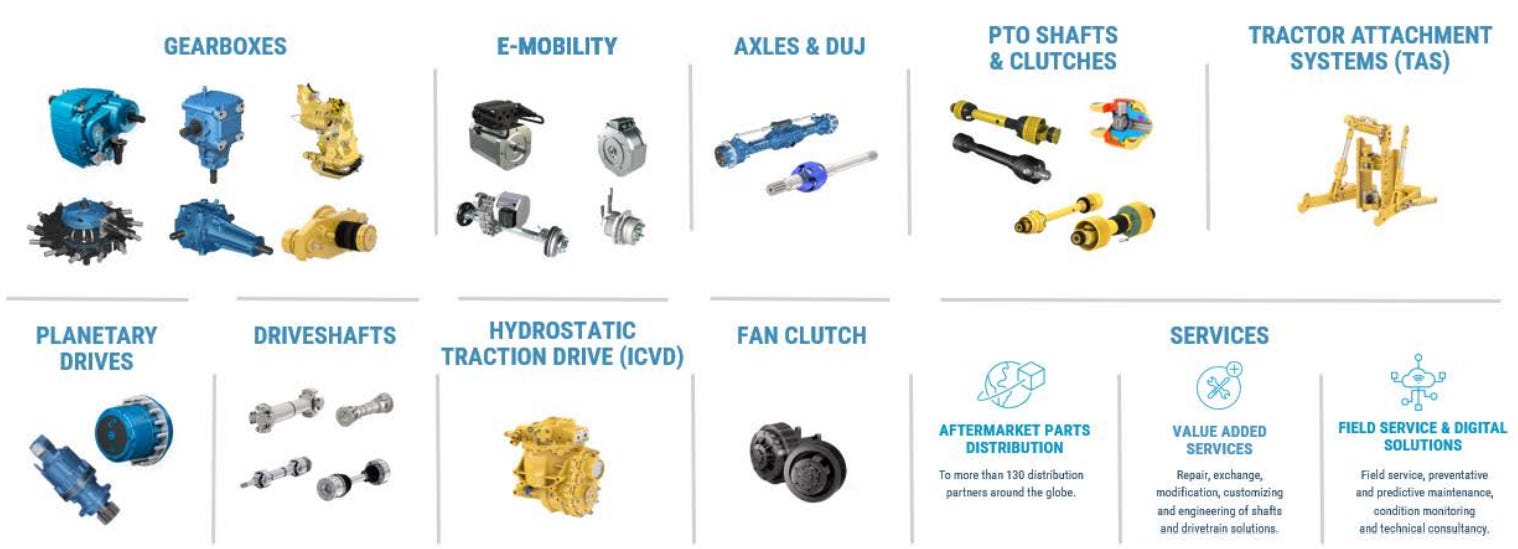
Comer Industries is the leading supplier of engineered transmission system for major vehicle manufacturers in the global agriculture, industrial and energy sectors.
In particular, the company offer includes products such as gearboxes, cardan shafts, offsets, multipliers, reducers and transmissions, etc. and is able to offer a particularly large number of models for various applications. The company also offers high value-added services to complete the offer to its customers.
The transmission systems constitute the "muscle" of the machines, and their quality
is essential for optimising the performance of the machines that use them, and
therefore for such machines to be successful on the market.
Comer Industries has 18 plants scattered around the world to cover all global needs: 8 Italy, 2 Germany, 3 USA, 2 Brazil, 1 China and 1 India. In addition, it has 4,000 employees in Europe, America and Asia.
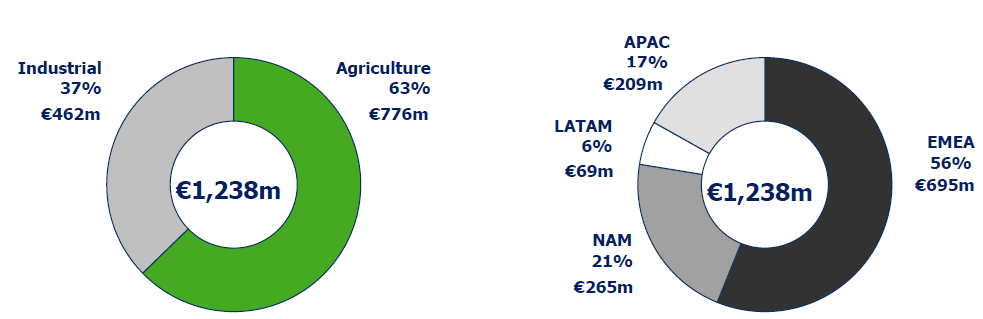
Historically the company is the undisputed leader in the agricultural niche and has a high reputation and prestige in the market. Nowadays is starting to extend its product range into the construction niche and other newer application areas such as renewable energy (wind).
Over time, Comer Industries has been able to build solid business relationships with the world's leading manufacturers of machines for agriculture, industry and renewable energies (Original Equipment Manufacturers - OEMs), simultaneously expanding its presence and dimension at an international level.
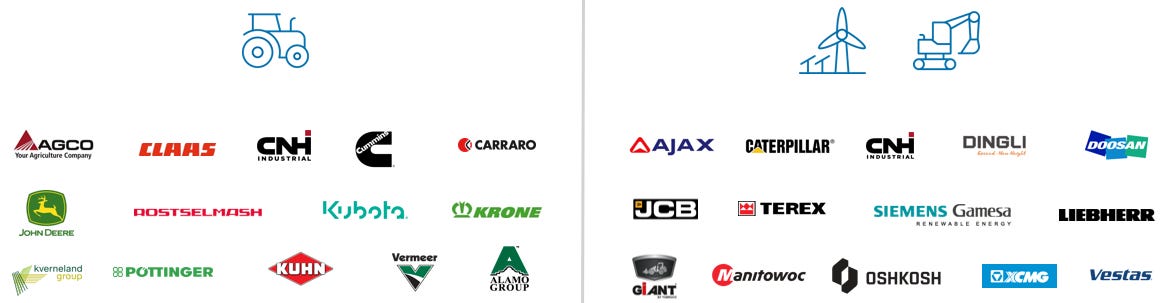
The company works with the best manufacturers in each niche, growth-cyclical companies such as John Deere or Caterpillar, absolute leaders in each of their segments. Once these manufacturers bring a product to market, they have no choice but to continue working with Comer, which designs, manufactures and develops these critical components. It is a market where reputation and long-term relationships are key.
Trends and market
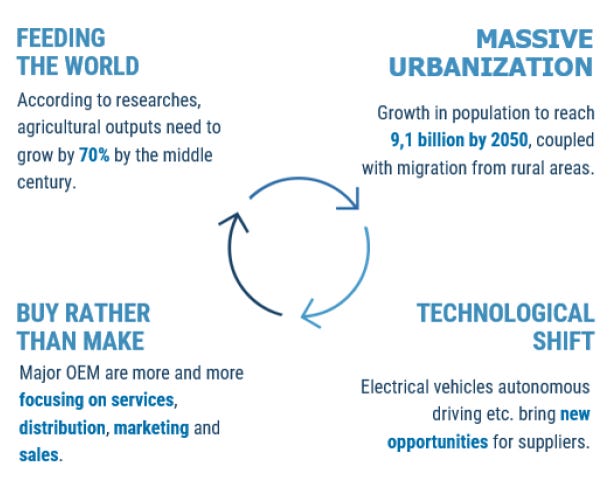
The strategy of the Comer Industries Group is therefore aimed at adapting its business model to these changes (climate change, world population growth, urbanisation, digitisation, infrastructure congestion), as well as seizing the opportunities which will arise from them, including growing demand for specialised and automated machines, offering advanced products capable of responding to market expectations.
Population growth and increased agricultural productivity. Over the next few
decades, the world's population is expected to continue growing at a rapid pace. The United Nations estimates that by 2050 the world population will reach 9.8 billion individuals. Remaining in a scenario of moderate economic growth, this demographic increase will lead, in 2050, to an increase in global demand for agricultural products by at least 70% compared to current levels, consequently requiring an increase in productivity and sustainability in both economic and environment for all levels of the production chain in the agricultural sector.
In order to satisfy the new level of demand for products, it will be essential to increase and maximize the efficiency of agricultural machinery and, upstream, the related constituent parts of such equipment.
Urbanization. The constant population growth worldwide and the growing weight of
the middle class, especially in the context of emerging markets, are contributing to
an increase in urban agglomerations, both in terms of size and numbers. This trend
represents a stimulating factor to encourage the realization of important projects,
particularly in the energy and infrastructure fields. In the near future it will therefore
be essential to design and build innovative mechanical means, capable of operating
effectively and efficiently in increasingly large and integrated contexts. Over the next
decade, the world market for large infrastructure projects will experience a significant
acceleration, greater than that of world GDP, reaching 15.5 trillion dollars in 2030
thanks to an average annual growth of 3.9%. The main contribution will be given by
three countries: the United States, China and India, which together will account for
57% of the total growth of the major works market.
The phenomenon of urbanization will not only have significant impacts in the industrial sector, as the progressive growth of agglomerations, destined to transform themselves into megalopolises, and the progressive inclusion of agricultural activities in the urban area, especially for small-scale productions, will be relevant elements also for the industry that produces technologies for the management of green areas, the so-called gardening tools -another segment of reference for the Group's products, including in the broader sector of agricultural equipment.
Population growth and increased agricultural productivity. Over the next few
decades, the world's population is expected to continue growing at a rapid pace.
Regulatory requirements. The diffusion of increasingly stringent regulatory
requirements and the increase in the demand for certifications to achieve high quality
standards determine the need to homologate the products to be used in the various
industrial sectors, also as regards the relative environmental performance. In the
European context, the introduction of new regulations at Community level imposes
the need to comply with them by adopting them and at the same time it is also a
source of potential business opportunities.

The global agricultural equipment market is estimated at USD 140 billion in 2017,
with over 5 million units sold, and is expected to grow at approximately 6% (CAGR)
over the period 2018-2024, at the end of which promises an estimate of the value of
more than 200 billion dollars. Agricultural machinery comprises a wide range of
equipment and tools used in various processes to improve crop quality and production.
On the basis of product types, the market can be divided into the following main
segments: tractors, combines, sprayers, land preparation and cultivation equipment,
seeders and others.
The constant increase in the demand for agricultural products, due to the exponential
growth of the population on a global scale, and the growing adoption of advanced
technologies, such as robotic systems integrated into agricultural equipment, can be
considered among the main drivers that will drive the growth of the agricultural
reference. The constant Research and Development activities carried out by the main
operators in the sector are oriented in this direction, in order to identify and introduce
technological innovations that lead to a reduction in timing and a simultaneous
increase in productivity. Modern technologies have begun a process of revolution in
agricultural techniques in use, contributing to increasing the quality and yield of crops, increasingly moving towards the new frontier of precision farming . In this context, it is expected that the growing need for mechanization of sowing processes will be a source of further growth in the agricultural equipment market, transforming many manual activities into fully automated procedures, thus eliminating inefficiencies and making simplifications.
In this sense, the frequency of use of drones and specialized robots is increasingly high, equipped with remote monitoring and control sensors and capable of automatically recording the data obtained (Source: Global Market Insights,
"Agriculture Equipment Market size worth over $200bn by 2024”). Within the sector, the role played by the regulatory context is not negligible.
On the one hand, the introduction of regulations, aimed at improving the environmental situation and at the same time the cultivation processes, entails the need for producers to create new equipment in order to comply with the requirements introduced and therefore also stimulates the production increase of related component parts. On the other hand, especially in emerging countries, the subsidies offered by local governments to farmers, with the aim of encouraging the adoption of the most recent cultivation systems and the most modern support equipment, are a source of further stimulus to market growth.
At a geographical level, the Asia-Pacific region represents the main market for
agricultural equipment, with a value of more than 60 billion dollars in 2017 and
promises rapid growth also for the coming years. The main factor driving market
development in these places is the promotion of government initiatives and subsidies
granted for the benefit of farmers, to encourage the adoption and purchase of
technologically advanced equipment and thus increase productivity.
North America is the second largest market globally and is the leading producer of
wheat, corn and soybeans, products that require the use of agricultural equipment
and therefore drive market growth. Within the North American market, the United
States plays a primary role, counting on more than 2.2 million farms. Worldwide, the
third position is occupied by the European market, with Germany and France in the
lead. In particular, Germany is among the main exporting countries of agricultural
machinery worldwide.
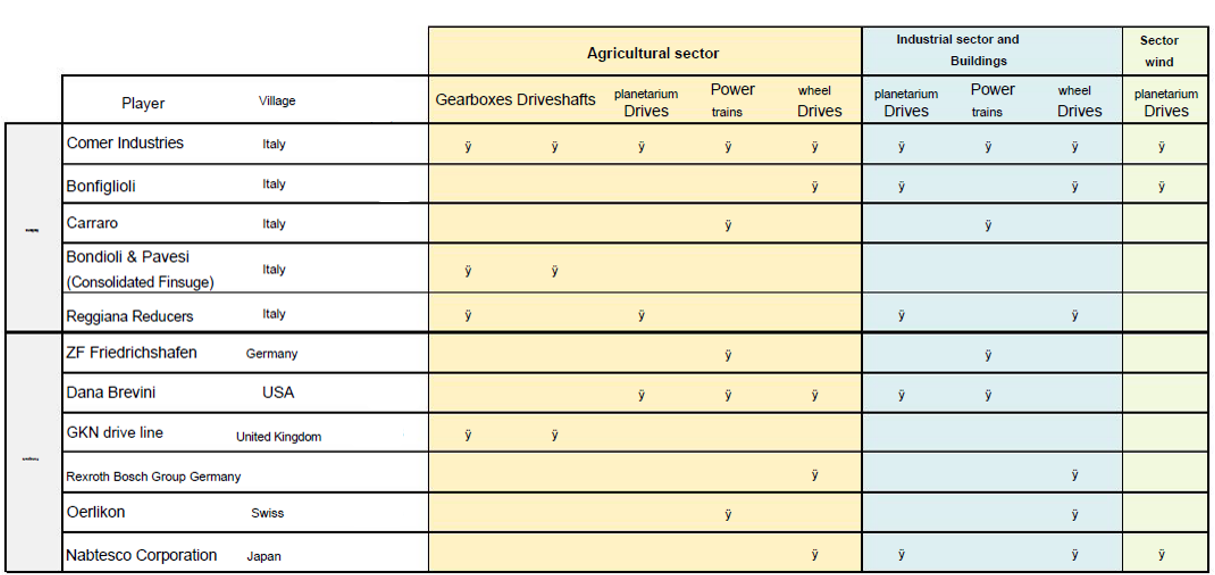
In the table above you can see some of the company's competitors. The table is outdated as it is from 2017, but it can serve as a practical exercise. There are very few companies currently listed on the stock exchange, but the ones that are listed are of fairly low quality (Oerlikon and Nabtesco) and are not comparable as most of them are only capable of manufacturing some of the components.
Internationally, the companies in this sector that export the most and are considered to be of the highest quality are the German and Italian companies followed by companies in the United States. In this market there are thousands of small businesses very focused on a specific market niche but no one covers the whole range of materials and services.
We therefore find that Comer Industries has the opportunity to consolidate all that value to offer it to increasingly globalised customers who are looking to simplify the number of relationships and suppliers in search of efficiency.
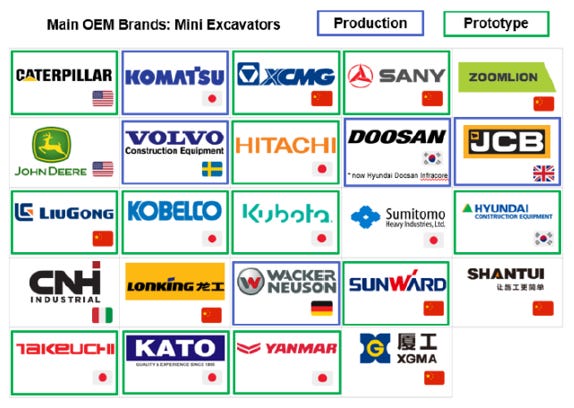
The management of the Comer Industries Group has identified some emerging
trends which should support the mechatronics market, with specific reference to the application areas of the products offered by the Comer Industries Group, in the medium-long term.
The growing level of innovation in the field of digital technology, automation and robotics is considered among the main trends that will affect many production sectors in the future, through the introduction of highly evolved and sophisticated tools such as advanced cybernetic sensors, augmented reality applications, machine learning and artificial intelligence. The use of systems equipped with high technological development will allow to increase productivity, rationalize the use of resources and reduce the related environmental impact, also leading to greater automation of many operations performed today manually.
Key growth factors:
Technological innovation with precision agriculture, autonomous vehicles and robotic solutions: the increased use of connectivity and automation is expected to increase the efficiency/productivity of tractors and combines, triggering a long overdue replacement cycle.
The outsourcing of a part of the production process, allowing OEM manufacturers to concentrate on two strategic phases: research and development and after-sales service.
Structural growth of the world population: it determines a greater demand for food and, consequently, larger fields and faster and more efficient agricultural equipment.
Strategy
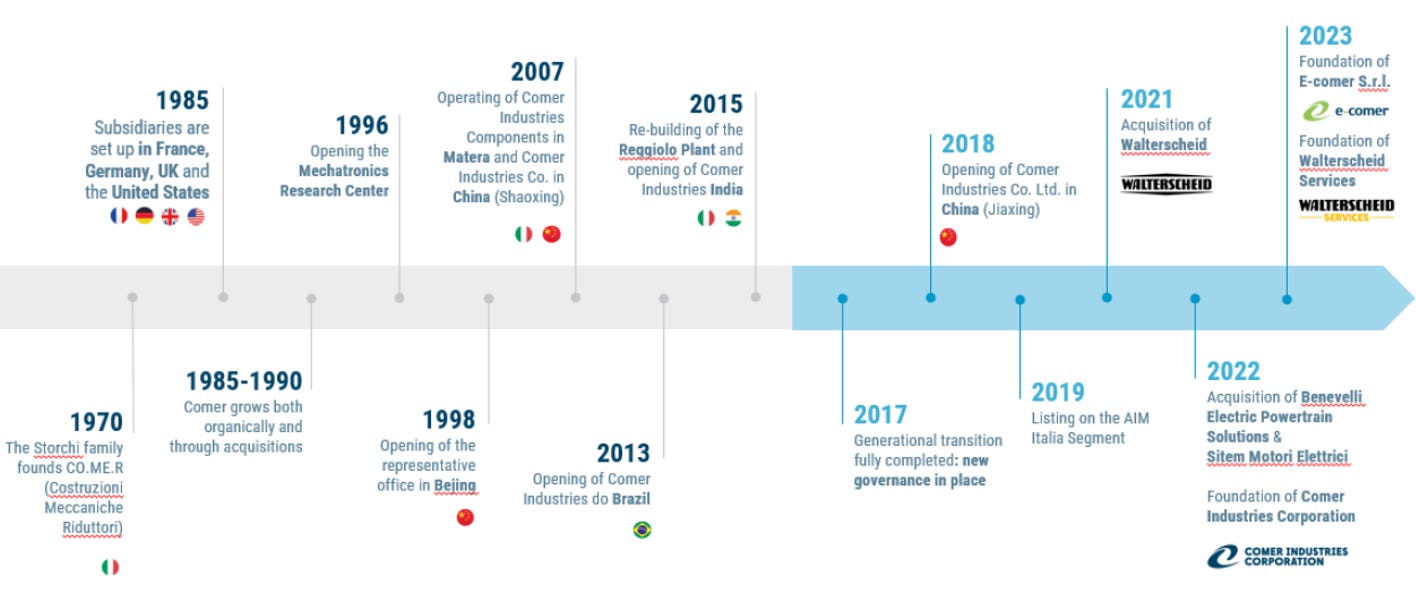
Comer aims to become the undisputed leader in the mechatronics segment worldwide with a value proposition towards its customers by focusing on product quality, long-term customer relationship management and increasing market share.
The keys to achieving this are:
Consolidate the market through M&A to gain more scale by reaching new customers and market segments.
In fact, Comer has recently acquired two small Italian companies focused on electrification in order to be able to offer its global customers solutions tailored to their needs.
Be strong in R&D in order to be able to impose sufficient barriers to entry and eliminate possible competition from less sophisticated suppliers. By doing so, companies that invest less in this area will gradually be left out of the most pioneering segments of the market (where the strongest growth is).
To be a sustainable company in order to be selected as a preferred supplier for its customers. Customers are outsourcing more and more production processes to their best suppliers over time and sustainability is the key long-term driver (in addition to quality, innovation, risk mitigation, etc.).
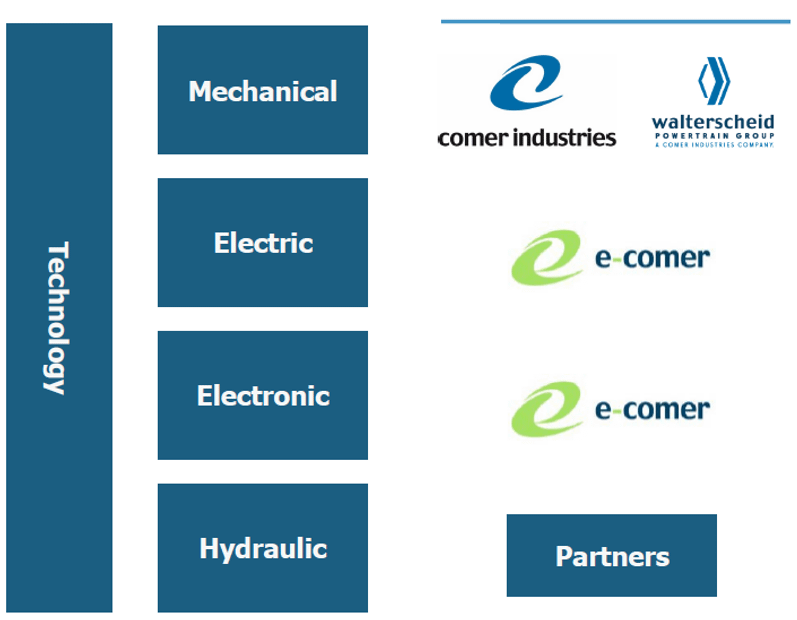
Below we will list the competitive advantages Comer has to lead in this niche market:
Solid and flexible business model underpinned by diversified product offering and innovation oriented which allows the Comer Industries Group
to respond quickly and effectively to customer needs and to manage production
activities efficiently. Furthermore, the Group carries out
continuous research and development activities, also in collaboration with its
customers, which makes it possible to satisfy their needs in terms of
technologically advanced products.Preferred supplier for top manufacturers of agriculture and industrial machinery
thanks to long term partnership with customers and suppliers.
Established portfolio of customers providing for visibility on backlog and resilience. Diversified product portfolio and therefore a very broad range of products, especially as regards the sector of transmission systems which allows the company to cover a large number of market sectors and to satisfy the most diverse requests from customers, also thanks to the high level of specialization achieved in product development and testing activities.
Strong international presence.
Brand reputation: among the world's leading manufacturers the source of a further competitive advantage, and, in addition, the presence of a corporate culture based on continuous improvement in terms of quality, safety, production and services offered has proved to be essential for building, nurturing and maintaining the position covered in the global competitive scenario.
Pricing power: the prices at which the products of Comer are sold are in most cases subject to periodic review. The contracts also usually contain clauses for indexing the prices themselves to the trend in exchange rates and the price of raw materials.
R&D: are of considerable importance, in order to maintain a constant competitive and highly advanced level of the components. The timeliness in the development of a new effective technology to be integrated into the production process represents a considerable competitive advantage for a player in the sector, capable of determining a significant impact on its share of market and in this sense the timing of development is a key factor for the market.
Risks
Price competition from low-cost countries: competition from suppliers who manufacture at lower cost is possible but never with the quality and level of innovation required by the world's top manufacturers.
OEM are able to vertically integrate the upstream phases of the production chain: This does not seem to be a very high risk either, as the trend for many years has been to outsource their development costs to their suppliers. These suppliers, like Comer, are acquiring such a vast knowledge of the subject that it seems difficult to believe that manufacturers will be concerned about these issues. OEMs want to focus on where they can add the most value, which is on the sales side and other post-sales services.
The company has little track record on the stock exchange: In my opinion this is the biggest risk because we do not know if the company will be good at integrating new businesses especially with very large acquisitions or if it will be able to obtain enough synergies to progressively evolve the % EBITDA and EBIT.